
If you drive your own car to help a qualified charity in 2026, write down the trip while you still remember it. Federal itemizers may be able to claim 14 cents per qualifying mile, plus unreimbursed parking and tolls. Virginia has a separate adjustment that can bring the mileage deduction to 18 cents per qualifying mile. The hours you give have value to your community, but the IRS does not assign them a charitable deduction. IRS mileage rates · Virginia mileage provision
Before you drive, ask what the organization needs
If you live in Manassas, Fairfax or Gainesville and want to help before December 31, start with a practical question: “Is there a task you need someone to do, and should I expect any expenses?” Getting an answer can save you a trip and help the coordinator match your time to work that needs doing.
Helping Hands for Nations Inc. invites volunteer applications for work such as event support, preparing supplies and administrative help. Some assignments require training or authorization. Ask the coordinator to confirm the task, location and reimbursement policy before buying supplies or making a delivery. Explore volunteer opportunities.
That advance check matters for planned initiatives, too. For example, Helping Hands for Nations describes its Virginia medical equipment and mobility initiative as a planned 2027 launch, subject to approvals and operating arrangements. Its program page says it is not yet accepting equipment orders. Read the equipment program update.
What belongs in a volunteer mileage log?
Suppose a Northern Virginia charity asks you to collect empty boxes for a packing day. You pick them up, deliver them and stop for groceries on the way home. That evening, you can probably recall where the grocery detour began. By filing season, the same trip may be just a number on your odometer.
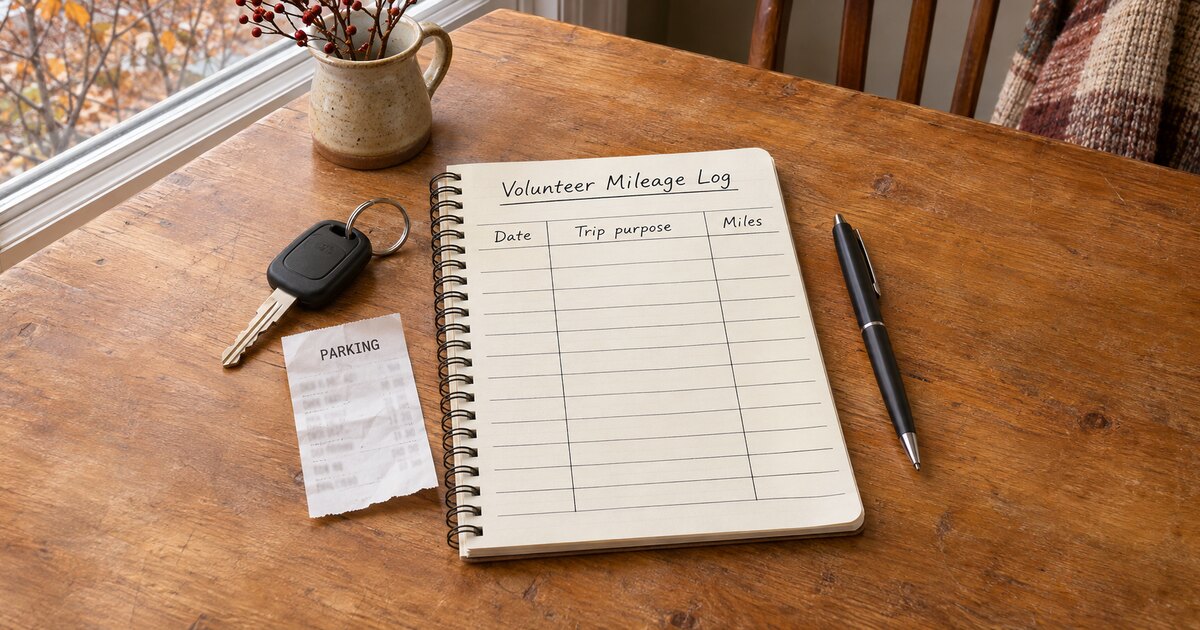
A notebook or phone note can capture what matters:
| Record | What to write down |
|---|---|
| Date and organization | The day you drove and the name of the qualified charity you served |
| Assignment and route | What the charity asked you to do, where you started and where the assignment ended |
| Charitable miles | The miles driven for the assignment, excluding extra miles for personal errands |
| Costs and reimbursement | Qualifying parking or tolls you paid, receipts, and anything the charity repaid |
For a federal itemized deduction, an expense must be unreimbursed, directly connected to the service and incurred only because you volunteered. Personal and family expenses are excluded. For your car, you can use the charitable mileage rate or the gas and oil costs directly attributable to the service. Choose one method for the same driving. Eligible parking and tolls can be added under either method. Ordinary repairs, insurance and depreciation do not qualify. IRS Publication 526 on volunteer expenses and records
How the federal and Virginia deductions work in 2026
On a federal itemized return, the 14-cent rate helps you calculate the amount attributable to eligible driving. A second calculation determines how much of your charitable giving you can deduct. Beginning in 2026, generally only the portion of total eligible charitable contributions above 0.5% of adjusted gross income qualifies for an itemized deduction. Other limits can also apply, depending on the gift, recipient and income. A well-documented trip can therefore produce no additional federal tax savings. IRS Publication 505
On a Virginia resident return, you generally use the same standard-or-itemized choice you made federally. For an eligible itemizer using the federal 14-cent rate, Virginia’s mileage adjustment generally adds 4 cents per qualifying mile, bringing the combined mileage amount to 18 cents. If you used actual expenses and they came to less than 18 cents per mile, Virginia Tax allows the eligible difference. Use the final 2026 Virginia instructions when preparing the return. Virginia Code § 58.1-322.03 · Virginia Tax instructions
A deduction reduces taxable income. A credit reduces tax owed. The 18-cent figure is a mileage calculation, not an 18-cent tax saving or a reimbursement. Any actual savings depend on the deduction you can use and the tax rate that applies to that portion of your income. IRS credits and deductions
What must happen by December 31?
For a calendar-year donor, the gift date determines the tax year. Log volunteer driving on the date of the trip. If you make a separate monetary gift, a bank credit-card contribution generally counts in the year the card is charged, even if you pay the bill in January. A check mailed to the charity generally counts on the mailing date, assuming it clears in due course. Starting a donation form or making a pledge does not complete a payment. Filing your 2026 return in 2027 does not extend the December 31 giving deadline. IRS contribution timing rules
The receipt deadline serves a different purpose. For an individual unreimbursed volunteer expense of $250 or more, keep proof of what you paid and obtain a written acknowledgment from the charity. It should describe your service and say whether you received goods or services in return, with a description and good-faith value estimate when required. Obtain it by the earlier of the day you file or the return’s due date, including extensions. If you plan to file early, ask for the letter first. IRS acknowledgment requirements
Frequently asked questions
Can I deduct my volunteer hours if I normally charge for this work?
No. A bookkeeper who volunteers an afternoon cannot deduct their usual hourly fee. An eligible expense they personally paid to carry out the assignment is a separate matter. IRS volunteer questions and answers
What if I take the standard deduction and give money instead?
Beginning in tax year 2026, eligible federal filers taking the standard deduction may deduct up to $1,000 in qualifying cash contributions, or $2,000 on a married filing jointly return, to certain eligible organizations. This provision covers qualifying monetary gifts. Keep the bank record or charity communication showing the organization, date and amount. For a single monetary gift of $250 or more, obtain the charity’s timely written acknowledgment as well. IRS guidance for nonitemizers · IRS recordkeeping requirements
Where can I give or learn more about helping locally?
If you have time to offer, start with the Helping Hands for Nations volunteer page. If a monetary gift fits your plans, the official Donate page links to the organization’s Zeffy checkout. Save the completed payment confirmation with your 2026 records.